
TL;DR
Most marketing teams ask the channel question too early. They want to know whether they should publish more on LinkedIn, run more paid social, or build more video. But the harder question comes first: once this work enters the feed, what is it actually competing against, and why should anyone choose it over everything else in front of them? That is the real battlefield. Brands do not only compete with category peers. They compete with creators, friends, entertainment, news, memes, and every other stimulus engineered to stop the scroll. Channel matters, but only after a team understands the attention market it is trying to enter.
Marketing usually loses long before the reporting deck explains why.
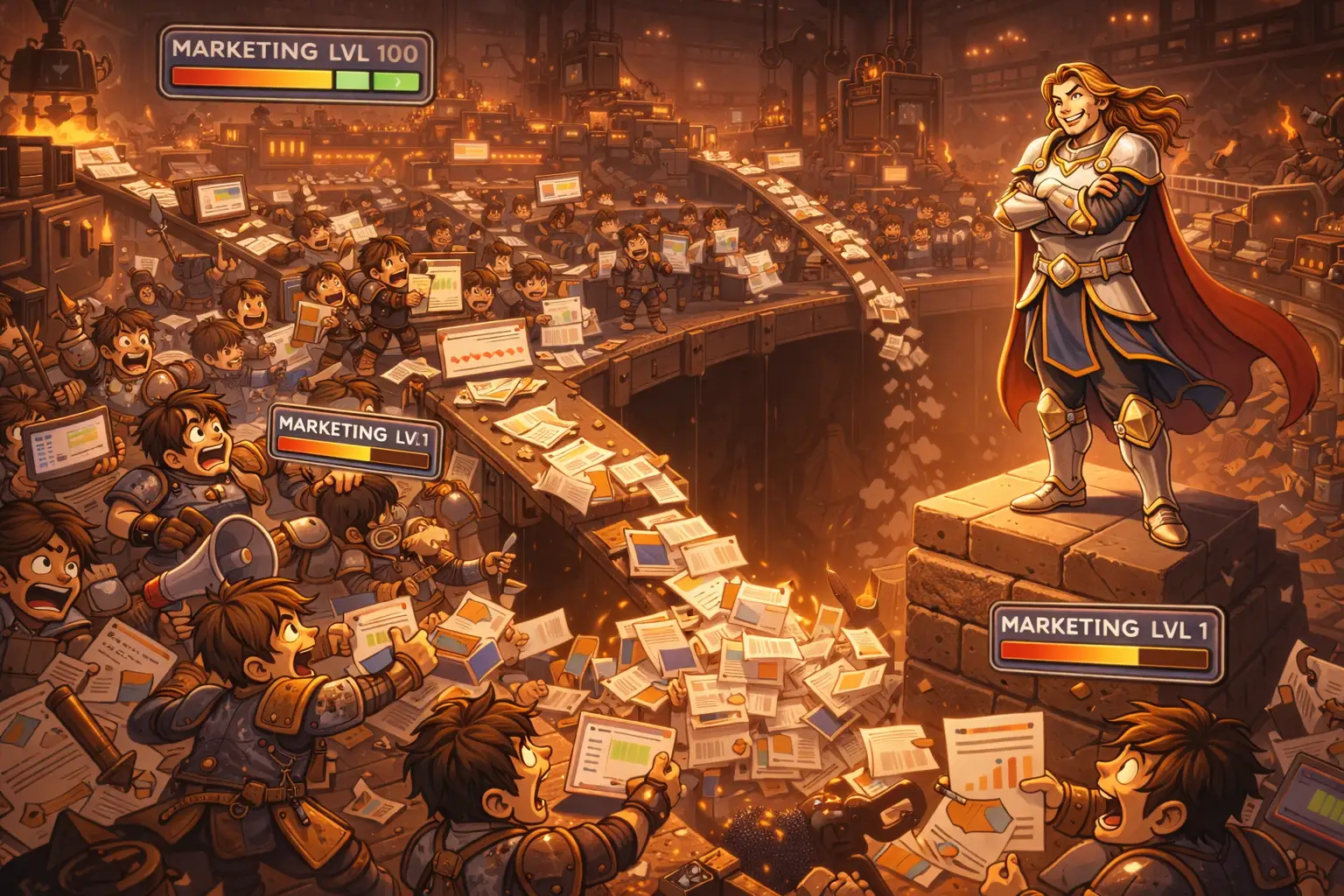
The work does not merely compete with rivals. It competes with the entire internet the audience would rather consume.
Disclosure: This page is editorial analysis of attention competition, channel choice, and platform-native behavior, supported by marketing research on social content performance and attention economics. Sources appear near the end.
One of the easiest ways to spot weak marketing strategy is to listen to the first question being asked.
If the discussion starts with “Should we be on TikTok?” or “How often should we post on LinkedIn?” the team is probably already operating too low down the ladder. Channel strategy matters, but it is not the first problem. The first problem is whether the work has any realistic right to win attention once it enters a crowded environment.
That is why this article sits naturally beside the apathy-marketing diagnosis. Apathy marketers tend to treat channels like checklists. Strong marketers start by studying the battlefield itself: what the audience is already consuming, what stops them, what they remember, and what would actually deserve the pause.
Your Real Competitors Are Broader Than You Think
When a brand publishes into a feed, it is not competing only with category peers. It is competing with personalities, creators, humor, outrage, status signaling, sports clips, friends, breaking news, and whatever else the platform is currently surfacing more aggressively than your message.
That sounds obvious once stated plainly, but most channel plans still behave as though the audience is waiting politely for branded information. They are not. Attention is already allocated. The default state of the feed is indifference. Your work has to interrupt that condition on merit, not on the basis that a team fulfilled a posting plan.
This is why safe content performs so weakly in crowded channels. It is usually not offensive enough to reject, but it is not compelling enough to choose. The market solves that by ignoring it.
Why Channel Usually Comes Second
The strongest marketers do not begin with platform loyalty. They begin with fit.
What kind of message actually survives in this environment? What emotional rhythm does the platform reward? What creative behavior feels native rather than bolted on? What would make a skeptical viewer stop rather than scroll? Those questions matter more than whether a channel looks fashionable in a strategy deck.
HubSpot’s social media trends work points in the same direction. Funny, relatable, and behind-the-scenes formats keep outperforming because they behave more like things people naturally want to consume. That is not a trivial platform lesson. It is proof that the feed rewards content that feels human and native rather than mechanically branded.
Why Weak Teams Misread The Problem
Weak teams often think the channel failed when the work never had a chance.
They launch more campaigns, produce more assets, and increase cadence because activity feels like effort and effort feels like control. But more content does not solve an attention deficit if the content never deserved the attention in the first place. It just produces more things to ignore.
This is where the gap between average marketers and alpha marketers gets clearer. Strong operators ask what the customer is seeing when the post appears. What is adjacent to it. What emotional state the audience is in. What claim would feel fresh instead of interchangeable. They think behavior first, not deliverable first.
What Better Marketers Do Instead
- They map the battlefield: what already dominates attention in the target environment.
- They study native behavior: what actually feels right for the medium.
- They ask if the idea deserves the pause: not just whether it fits the calendar.
- They choose channels selectively: some ideas should not be forced into some feeds.
- They adapt the message to the medium: attention has to be earned in the language of the platform.
That is what separates channel strategy from channel superstition.
Conclusion
Attention is the real battlefield because the work must beat an environment, not just a rival. Until a team understands that, channel strategy is often just activity wearing the costume of sophistication.
The practical lesson is simple. Ask the attention question first. If the work would not win inside the feed it is entering, the channel choice is already downstream of a bad decision. Better marketers know that the medium is only useful once the idea has earned the right to be there.
Sources
Permission, Not Interruption — The Marketing The Article Is Actually Describing
Here is the thing about attention. Everybody wants it. Almost nobody earns it. And the marketers who keep trying to grab it are the ones complaining loudest that it is harder to get than it used to be. The complaint is correct. The diagnosis is wrong. Attention is not harder to get because audiences have changed. Attention is harder to get because the techniques that grabbed it in 2010 were techniques of interruption, and the audiences in 2026 have spent fifteen years learning to ignore interruption with the kind of precision that only fifteen years of repetition can produce.
The article you just read describes the symptoms accurately. Most marketing fails before the change-the-customer step because most marketing is interrupting people who did not ask to be interrupted and were not going to listen to the interruption even if the interruption had been better executed. That diagnosis points at a different solution than the one most marketing departments choose. The chosen solution is louder interruption. The actual solution is permission.
Permission marketing is the practice of earning the right to deliver a message to someone who is, at the moment they receive it, expecting it and welcoming it. It is anticipated, personal, and relevant. Each of those three words is doing real work. Anticipated means the person knows the message is coming and has agreed to receive it. Personal means it is for them specifically, not a broadcast that happens to be addressed to them. Relevant means it concerns something they actually care about, today, in the situation they are actually in. The marketing that wins the attention battle is the marketing that earns all three. The marketing that loses is the marketing that achieves none of them and substitutes volume for permission, hoping that if it shouts loudly enough, the lack of permission will not matter. It always matters.
The hardest thing about permission marketing is that it starts very small. You do not get a million people to grant you permission. You get one. Then you treat that one person’s permission so seriously, deliver on it so thoroughly, that they tell another person, who watches you for a while and decides to grant you permission too. The work compounds slowly at first and then exponentially. Most marketers do not have the patience for the slow part, which is why most marketers never get to the exponential part. The interruption marketers are still doing interruption in year three because they could not bear to watch year one’s small numbers.
Here is what the article does not quite say but ought to. The customers who matter most to your business are the customers who would grant you permission if you asked for it correctly. The customers who you cannot reach through interruption are the same customers who would have welcomed you if you had earned the right to be welcomed. The lost-attention problem and the lost-permission problem are the same problem viewed from two angles. Solving for permission solves for attention as a side effect. Solving for attention without solving for permission produces marketing that scales by spending more and stops scaling the moment you stop spending. That is not a marketing strategy. That is a treadmill.
There is a quieter implication for the people inside marketing departments. Most marketing departments are organised around interruption — the team that buys media, the team that produces creative for that media, the team that measures the response. None of these teams is organised around earning permission, because permission cannot be bought from a media plan, cannot be produced as creative, and shows up in measurement only as a lagging indicator that the conventional reports do not track. The internal politics of a marketing department will resist the move toward permission because permission does not produce the deliverables the department is structured to produce. The CMO who wants to make the shift has to do more than change the strategy. They have to change the org chart.
The org-chart change is the unglamorous heart of the work. A permissions team — a small one, with a long horizon and a tolerance for slow compounding — operating alongside but not inside the interruption machine, reporting to the same CMO but measured on different things. A subscriber list that grows from real interest, not from gated lead-magnet downloads. An email cadence that the recipients look forward to. A content rhythm that respects the recipient’s time. Each of these is technically easy and organisationally hard, which is why most companies do not do them and why the companies that do are pulling away. The apathy-marketing pattern is the visible artefact of organisations that have stopped earning permission and started signalling activity instead. The cure is not better creative. The cure is to remember whose attention you are asking for, why they should grant it, and what you owe them once they have.
The marketers who internalise this stop competing for attention and start serving the audience that has chosen them. They stop measuring impressions and start measuring whether the people they reached came back. They stop launching campaigns and start running ongoing relationships. The work looks smaller. The results, given a few years, are not small at all. They are the only results that compound, and compounding is the only path to a marketing program that still works in 2030.
Pick a hundred people. Earn their permission. Make them so glad they granted it that they tell ten others. Then a thousand. Then ten thousand. The attention battle was lost the moment we started measuring how loud we could be. It is won, slowly, by deciding to be quiet enough to be listened to, useful enough to be remembered, and consistent enough to be trusted. That is the work. The rest is noise.
One more thought, because the permission frame produces a question that most strategy decks dodge. What are you doing this week that earns the permission you will need next year? Not what are you launching, what are you announcing, what are you spending. What did you do this week, specifically, that makes one more person glad they hear from you. If the answer is nothing — if the week was full of activity but none of it earned a single new piece of permission — then the week was a treadmill week, and you spent the company’s money to stay exactly where you started. Most weeks at most companies are treadmill weeks. The marketers who notice this and quietly start picking different work are the ones whose next year looks different from their last year. The rest are still busy. Busy is not the goal. Earning the permission to be heard is the goal, and it is measurable, and it is the only metric in the marketing department that compounds across years instead of resetting each quarter.
The discipline is the same one good writers and good teachers know. Show up. Be useful. Tell the truth. Respect the reader’s time. Do it again tomorrow. The audience grows because you earned the growth, not because you bought it. The growth, once earned, is more durable than any acquired growth has ever been, in any era of marketing, including this one. That is the permission dividend. It pays out in years, not quarters. Run a marketing program built to collect it.